What to Do in Kanazawa at Night: A Cultural Evening Beyond Bars and Restaurants
- 5 hours ago
- 4 min read
Kanazawa is easy to fill with extraordinary experiences during the day.
Kenrokuen Garden, Kanazawa Castle, Omicho Market, contemporary art, samurai neighborhoods and historic teahouse districts can occupy even the most ambitious itinerary.
Then evening arrives.
For many first-time visitors, the obvious question is:
What is there to do in Kanazawa at night?
Restaurants and bars are certainly part of the answer. Kanazawa has one of Japan's most compelling regional food cultures.
But travelers looking for something deeper can use the evening to discover another side of the city: traditional entertainment, geiko culture and the intimate hospitality of an ozashiki.

Table of Contents
1. Why Kanazawa Changes After Dark
Kanazawa is often described through its visual beauty.
Wooden machiya townhouses. Stone paths. Garden landscapes. Gold leaf. Ceramics. Kimono.
At night, however, the city becomes quieter and more atmospheric.
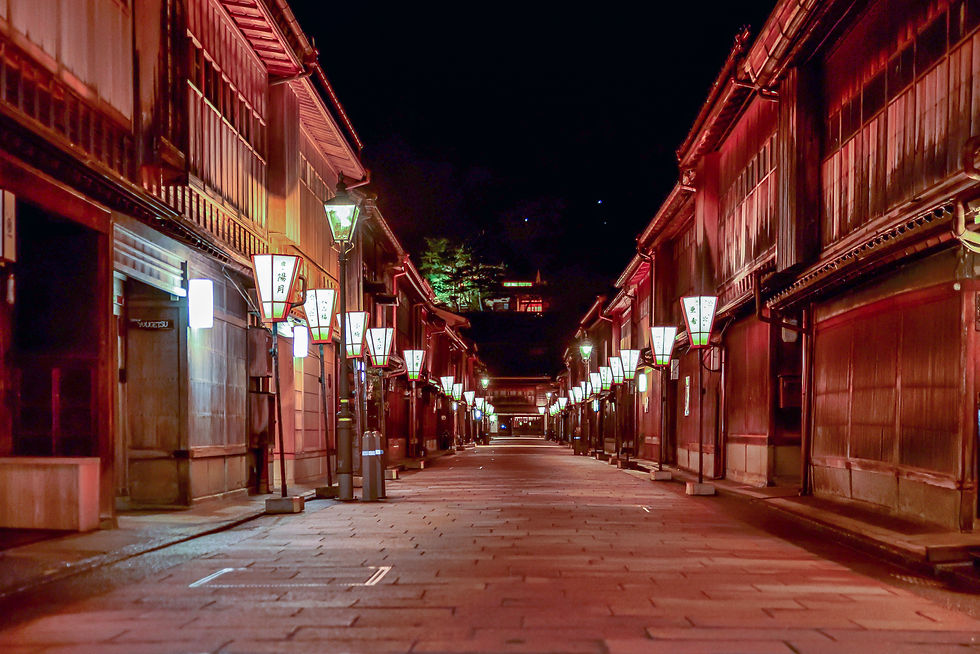
Day visitors leave the major sightseeing districts. Shopfronts close. Lanterns illuminate narrow streets. Historic wooden buildings take on a different character.
This is particularly noticeable around the traditional chaya districts.
During daylight hours, Higashi Chaya is one of Kanazawa's best-known sightseeing areas.
But the word chaya originally referred not to a modern tea shop but to a sophisticated entertainment venue.
Understanding Kanazawa after dark means rediscovering this original function of the city.
2. Is Kanazawa Worth Exploring at Night?
Absolutely—but it helps to approach the evening differently from Tokyo or Osaka.
Kanazawa is not primarily a destination for enormous entertainment districts, neon streets or all-night nightlife.
Its strength is intimacy.
A memorable Kanazawa evening might involve an exceptional seasonal dinner, local sake, a walk through a historic neighborhood, a small bar—or a private encounter with one of the city's traditional performing cultures.
The city rewards quality over quantity.
Instead of asking, “How many places can we visit tonight?” consider asking:
“What can we experience here that would be difficult to experience anywhere else?”
That question leads to a very different itinerary.
3. Three Ways to Spend an Evening in Kanazawa
Option 1: Explore Kanazawa's Food Culture
Seafood from the Sea of Japan, Kaga vegetables, local sake and sophisticated regional cuisine make dinner an essential part of visiting Kanazawa.
For food-focused travelers, a chef's counter or traditional restaurant can easily become the highlight of an evening.
Option 2: Discover Local Bars and Sake
Kanazawa also has an appealing small-scale bar culture.
Rather than searching for a large nightlife district, consider exploring intimate establishments and learning about Ishikawa's sake and local ingredients.
Option 3: Experience an Ozashiki
For travelers whose priority is culture, an ozashiki offers something completely different.
Music, dance, conversation and traditional games take place in an intimate Japanese setting.
Rather than watching Kanazawa from outside, guests participate in one of its living traditions.

4. What Is an Ozashiki Experience?
An ozashiki is a traditional gathering in a tatami room where guests are entertained by professional geiko.
Depending on the arrangement, the experience may feature shamisen music, traditional songs, dance, conversation and ozashiki games.
The room itself matters.
Unlike a theatre, there may be little separation between guest and performer.
You notice the sound of the shamisen directly.
You can see the precise movements of a dancer's hands and fan.
You can observe the details of kimono and traditional etiquette.
Then the atmosphere can suddenly change as guests are invited to join a game.
This movement between formality and informality is part of the fascination of ozashiki culture.
5. What Makes the Experience Different from a Cultural Show?
Large performances have advantages: elaborate staging, many performers and easy accessibility.
An ozashiki offers something else.
Proximity.
The experience is small enough for interaction to matter.
Instead of asking only, “What did I see?”, guests may leave thinking:
“What did we talk about?”
“What did I learn?”
“What game did I play?”
“How did the atmosphere change during the evening?”
These are personal memories rather than observations.
That distinction is particularly important for travelers who have already visited Japan before and are looking beyond the standard sightseeing circuit.
6. Who Will Enjoy an Ozashiki?
First-Time Visitors to Japan
An ozashiki provides a concentrated introduction to several Japanese traditions at once.
Repeat Visitors
Travelers who have already seen Japan's major temples and landmarks often appreciate opportunities for more personal cultural access.
Couples
The intimate atmosphere makes it particularly suitable for anniversaries, honeymoons and special journeys.
Families and Private Groups
Interactive elements such as traditional games can make the evening engaging across generations, depending on the program.
Art and Culture Travelers
Guests interested in dance, music, textiles, architecture or Japanese aesthetics can observe how these disciplines come together in one environment.
Luxury Travelers
For high-end travelers, the greatest value may not be extravagance but access to people and places that cannot easily be encountered independently.
7. How to Plan Your Evening
Advance planning is recommended for cultural experiences involving professional performers.
Unlike a museum or attraction with fixed opening hours, an authentic ozashiki depends on the schedules of performers


