Princess Tama and Tentoku-in Temple: A Hidden Story of Samurai-Era Kanazawa
- 2 hours ago
- 6 min read

Kanazawa is famous for Kenrokuen Garden, Kanazawa Castle, samurai districts, and beautifully preserved traditional streets. Yet beyond these well-known sights lies a quieter story that helps explain why Kanazawa flourished during the Edo period.
It is the story of Princess Tama, known in Japanese as Tamahime (珠姫).
Born into the powerful Tokugawa family and married into the Maeda family of Kaga Domain, Princess Tama became an important link between two of the most influential samurai families of early 17th-century Japan.
Her story is preserved today at Tentoku-in Temple, a historic Zen temple in Kanazawa.
Even more remarkably, her memory continues through living traditions. One striking example is the dedication of iaido, the Japanese art of drawing the sword, performed at Tentoku-in in her honor.
For travelers who want to understand Kanazawa beyond its famous tourist attractions, the story of Princess Tama offers a fascinating window into the city’s samurai history.
Table of Contents
1. Who Was Princess Tama?
Princess Tama (Tamahime) was born in 1599 as the daughter of Tokugawa Hidetada, who would become the second shogun of the Tokugawa shogunate
Her mother was Oeyo, also known as Go, and her grandfather was Tokugawa Ieyasu, the founder of the Tokugawa shogunate.
This placed Princess Tama at the very center of Japan’s emerging political order.
But her importance to Kanazawa began when she was still a small child.
In 1601, at only three years old, she was sent from Edo to Kanazawa to become the future wife of Maeda Toshitsune, who later became the third lord of Kaga Domain.
This was not simply a family marriage.
It was deeply political.

2. Why Did Princess Tama Come to Kanazawa?
To understand her marriage, we need to return to the beginning of the 17th century.
Japan was emerging from generations of warfare. Tokugawa Ieyasu was consolidating power, while the Maeda family controlled the enormous Kaga Domain, covering much of present-day Ishikawa and Toyama and part of Fukui.
The Maeda were among the wealthiest and most powerful feudal families in Japan.
Relations between the Tokugawa and Maeda families were therefore extremely important—and potentially dangerous.
Amid political tensions, the Maeda family sought to demonstrate that it had no intention of opposing Tokugawa rule.
A marriage was arranged between Princess Tama and Maeda Toshitsune.
The young princess therefore traveled from Edo to Kanazawa at the age of three.
Her marriage symbolized a powerful connection between the Tokugawa shogunate and the Maeda family of Kaga.
3. Princess Tama and the Peace of Kaga Domain
Princess Tama formally married Toshitsune at the age of 14.
Over the following years, she had eight children—three sons and five daughters.
Her life was short. She died in 1622 at only 24 years old following childbirth.
Yet her historical significance extended far beyond her lifetime.
As both a Tokugawa princess and the wife of the lord of Kaga, she represented the relationship between Edo and Kanazawa during a period when political stability was essential to the survival of powerful feudal domains.
For this reason, Princess Tama is remembered in Kanazawa not simply as a historical princess, but as a woman whose life became closely connected with the peace and prosperity of Kaga Domain.
After her death, she was buried in Kanazawa. A temple was established in her memory and named after her posthumous Buddhist name:
Tentoku-in.

4. What Is Tentoku-in Temple?
Tentoku-in (天徳院) is a Soto Zen temple located in the Kodatsuno area of Kanazawa.
It is best known as the temple associated with Princess Tama and the Maeda family.
Unlike some of Kanazawa’s busiest tourist attractions, Tentoku-in offers visitors a quieter and more contemplative encounter with the city’s history.
The temple preserves the memory of Princess Tama while also introducing visitors to Buddhist culture, the Maeda family, and Kanazawa’s Edo-period heritage.
One of its most impressive architectural features is its historic sanmon temple gate, which is designated as a cultural property.
Walking through the gate provides a very different atmosphere from the commercial streets of central Kanazawa.
Here, history feels personal.
Rather than simply learning about samurai lords and battles, visitors encounter the story of a young woman whose marriage helped connect two of Japan’s most powerful families.
5. What Can You See at Tentoku-in?
Tentoku-in contains a number of cultural treasures connected with Buddhism, the Maeda family, and Princess Tama.
Among the most personal objects is a set of paper hina dolls said to have been handmade by Princess Tama herself.
The temple also preserves Buddhist statues, historic furnishings, a temple bell, and a culturally designated tea kettle associated with the Kanazawa casting tradition.
For international visitors, one of the most accessible introductions to the history is the temple's presentation of the “Story of Princess Tama and Tentoku-in.”
A traditional karakuri mechanical puppet performance recounts the life of Princess Tama, while a digital slideshow is also presented at scheduled times.
These presentations make the complicated political history of the early Edo period easier to understand, particularly for visitors unfamiliar with Japanese history.
6. Iaido Dedicated to Princess Tama
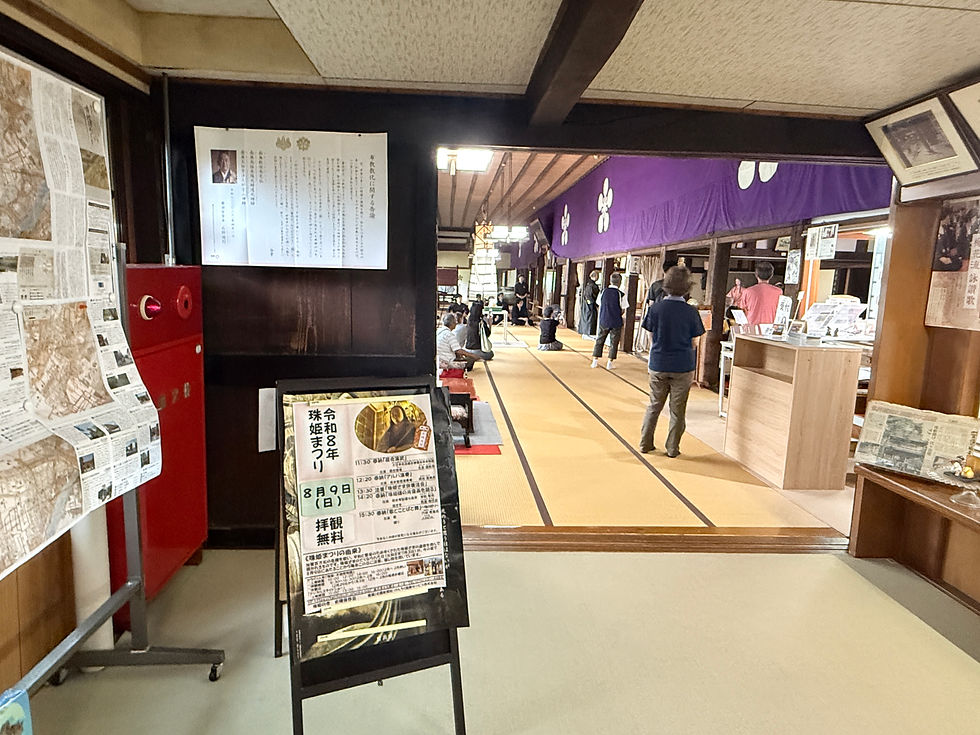
One of the most fascinating ways in which Princess Tama's memory has been honored is through iaido demonstrations dedicated to her at Tentoku-in.
Iaido is a traditional Japanese martial art centered on drawing the sword smoothly and precisely, responding to an imagined opponent, and returning the sword to its scabbard.
At the Tamahime Festival, practitioners of Muso Jikiden Eishin-ryu have performed iaido as a ceremonial dedication.
An account of the 2014 festival describes four practitioners performing following a Buddhist memorial service for Princess Tama.
The tradition itself had an unusual connection to her.
Iaido instructor Kunihiro Kitajima had previously practiced at Konohana Kindergarten in Kanazawa. Practitioners were taught to bow toward an area associated with Princess Tama, and a memorial tablet bearing her posthumous Buddhist name was later confirmed there.
This connection eventually led to iaido being formally offered in her memory at Tentoku-in.
The result is something very different from a staged “samurai show.”
The swordsmanship becomes an offering.

7. Why Iaido Is More Than Samurai Swordsmanship
International visitors sometimes associate Japanese sword culture primarily with samurai battles. Iaido reveals another dimension.
The emphasis is not simply on cutting or fighting. Practitioners train in posture, breathing, awareness, etiquette, timing, and precise control of the sword.
Before and after practice, respect is expressed through formal bows and ritualized movements.
When iaido is performed as a dedication at a Buddhist temple, these qualities become especially visible.
The sword—one of the most recognizable symbols of the samurai—is transformed from a weapon into a medium through which respect and remembrance can be expressed.
That makes the iaido dedication to Princess Tama particularly meaningful.
It connects three elements of Kanazawa culture:
samurai heritage, spiritual tradition, and historical memory.
8. Why Visit Tentoku-in in Kanazawa?
Many travelers visit Kanazawa to experience the world of the samurai.
They walk through the Nagamachi Samurai District, visit Kanazawa Castle, and explore gardens created by the Maeda family.
Tentoku-in adds another layer to that story.
Kanazawa's history was not shaped by warriors alone.
It was also shaped by marriage, diplomacy, religion, family relationships, culture, and political negotiation.
Princess Tama represents this lesser-known side of samurai history.
Visiting Tentoku-in therefore helps travelers understand why Kanazawa became one of Japan's great castle towns—and how the Maeda family maintained its position during more than two centuries of Tokugawa rule.
It is particularly recommended for travelers interested in:
Samurai and Edo-period history
Powerful women in Japanese history
Traditional Japanese martial arts
Buddhism and Zen temples
The Maeda family and Kaga Domain
Hidden historical sites in Kanazawa
Cultural experiences beyond the standard sightseeing route
9. Practical Information
Tentoku-in Temple
Japanese name: 天徳院Location: 4-4-4 Kodatsuno, Kanazawa, Ishikawa 920-0942, Japan
Opening Hours
March–November:9:30 a.m.–4:30 p.m.Last admission: 4:00 p.m.
December–February:9:30 a.m.–4:00 p.m.Last admission: 3:30 p.m.
Admission
Adults: ¥500Junior high school students: ¥300Elementary school students: ¥200
Opening times, performances, admission fees, and holidays can change, so travelers should check the latest information before visiting.
10. Discover Kanazawa’s Living Samurai Culture
Kanazawa's samurai history does not survive only behind museum glass.
It can still be found in temples, martial arts, traditional crafts, historic neighborhoods, ceremonies, and stories passed from one generation to another.
The story of Princess Tama is a perfect example.
A three-year-old Tokugawa princess arrived in Kanazawa more than four centuries ago. Her life became intertwined with the fate of the Maeda family and the history of Kaga Domain.
Today, visitors can walk through the gates of Tentoku-in, discover her story, and encounter cultural traditions that continue to honor her memory.
And through arts such as iaido, the spirit of Kanazawa's samurai heritage remains something that can be experienced—not simply observed.
For travelers seeking a deeper understanding of Kanazawa, Tentoku-in and the story of Princess Tama offer a compelling journey into the human side of samurai history.